Kallakurichi is one of the 38 locales which have a place with Tamil Nadu state arranged on the southern tip of India. The region settled is Kallakurichi. Kallakurichi locale was reported on 8 January 2019 and it appeared on 26 November 2019 when it was cut out of the Villupuram region. It covers 6 taluks specifically Kallakurichi, Sankarapuram, Chinnasalem, Ulundurpet, Thirukovilur, and Kalvarayanmalai.
History
By bifurcating Viluppuram locale on the floor of the Assembly by the Hon'ble Chief Minister on 8 January 2019, Kallakurichi District is proclaimed as the 33rd city. Later the new Kallakurichi District was rendered according to G.O.(MS).No.424 and 425 Tax and Emergency Management Branch, Revenue Administration Wing, {RA 1(1)} Section, Dated:12.11.2019. The Hon'ble Chief Minister then launched Kallakurichi on 26.11.2019 as the 34th region (Tenkasi implemented as 33rd) in an impressive debut job.
The region comprises 2 Revenue divisions with 6 taluks, comprising 562 Revenue towns in 24 firkas. The region comprises 9 improvement blocks covering 412 town panchayats. Kallakurichi, the central command of the locale is situated along NH 79 (Ulundurpet – Salem). Salem, Trichy and Pondicherry are the closest air terminals.
The region is an agrarian with paddy, maize, sugarcane, dark gram and so on, as significant harvests. The region is essentially rainfed/tank inundated alongside Gomukhi and Manimuktha dams.
Kalvarayan slopes spread across 550.70 Sq km, is a significant fascination of the region. The ancestral populace overwhelmed slopes have Periyar falls, Megham falls, Sirukalur falls and Chinnathirupathi sanctuary. Famous sanctuaries, for example, Ulagalantha Perumal sanctuary, Veerattaneshwarar sanctuary and Kabilar hillock in Tirukoilur, Sri Lakshmi Narasimhar sanctuary, Parikkal in Ulundurpet taluk, Adhirangan Ranganathaswamy sanctuary, Thiruvarangam and Arthanareeswarar sanctuary, Rishivandiyam in Sankarapuram taluk are arranged in this locale.
Kallakurichi area includes 2 Revenue Divisions, 6 Administrative Taluks, 562 Revenue Villages, 1 Municipalities,7 Town Panchayats, 9 Blocks and 412 Village Panchayats.
Spots of Interest
Kallakurichi is the area base camp of the Kallakurichi District, which was bifurcated from the recent composite Viluppuram District from 22nd September, 2019. It lies in the Chennai – Selam National Highways. It is very much associated with the rail and street, Chinnasalem is close to the Railway Station. From here one can go to any side of the Tamil Nadu just as to another piece of India. This locale has an assortment of places of interest which are over 100 years of age. The area has sanctuaries, masques and chapels which are extremely old and popular. We are inviting you to visit our region's traveler places.
Farming
Viluppuram is one of the overwhelming horticultural areas in which 75% of the populace is occupied with Agriculture and associated exercises for their occupation. Horticulture keeps on being the transcendent area of the District economy. In the complete Geographical region of 722203 Ha., 45 % (i.e.) 337305 Ha. is net planted territory. In the net planted zone, 137647 Ha. is planted more than once. The editing power which alludes to the proportion between net territory planted and net planted region is 1.40, which is higher than the State normal of 1.25.
Viluppuram District has 5.68 Lakh ranch families. In this 75% are minor ranchers, 16% has a place with little ranchers and 9% are enormous ranchers. The huge ranchers portion of 42% which is higher than the State normal 34%.
The primary water wellspring of the region are open wells and borewells. Net flooded zone of the area is 2.43 L.Ha. This records 33.6% of the complete region and 72% of Net planted region. The significant repositories of the region Veedur, Gomuki and Manimuthar waters 18553 Ha. Furthermore, Sathanur covers 35000 Ha. The normal yearly precipitation of the area is 1060 mm. In this 638 mm. got (60 %) during the North East Monsoon.
Paddy is the chief harvest broadly developed in every one of the three seasons to be specific Sorvari, Samba and Navarai.
Paddy records to 40% of the absolute edited zone in the locale. Heartbeats is another significant food grain crop. Blackgram is a dominating heartbeats crop which covers over 80% of the complete heartbeats territory in Viluppuram District. Sugarcane is a significant business crop in Viluppuram District supplies whole sticks for 7 sugar factories situated inside the area and halfway stick flexibly for 5 other sugar plants situated in the neighboring locale. Thus the region goes about as the sugar bowl of Tamil Nadu.
Villupuram region shares an amazing spot in State food grain creation. From 2013-14 to 2017-18, Viluppuram area stands first in food grain creation. Every year Viluppuram offers over 10% of the State's food creation.
Ranchers of this area are pioneers in receiving agrarian innovations. So Viluppuram consistently stands as a pioneer in the Agricultural Production area.
Agrarian division talently faces the test of accomplishing high development proportion by effectively actualizing different advancement plots and united advances.
To improve the rancher's financial circumstance through worth added items and expanded pay, we are executing plans like, NMSA, MSDA, Collective cultivating, Micro Irrigation, Bio manures, SSI, INM, IPM notwithstanding ordinary plans like yield turn and harvest extension innovations.
Framework offices
Government Seed Farm at Kakuppam, Iruvelpattu, Vadakkanandhal and Vanur
The goal of the Seed Farm is, providing the ranchers quality and affirmed seeds by increasing Breeder and Foundation seeds at the seed homestead and providing them to ranchers through AEC for duplicating Certified Seeds in their fields as seed ranches. Paddy, Groundnut, Blackgram, Greengram, Cumbu, Ragi and Gingelly seed ranches are significant pieces of seed creation programs at Government Seed Farms.
Coconut Crossing Center, Marakkanam
The target of Coconut Crossing Center is to gracefully quality Tall x Dwarf coconut seedlings to the ranchers.
Fluid Bio compost Lab, Mugaiyur
The target of the Liquid Bio Fertilizer Lab is to create biofertilizers like Azospirillum (Paddy), Azospirillum (Others), Rhizobium (Pulses), Rhizobium(Groundnut) and Phosphobacteria in fluid state and providing them to ranchers and consequently expanding Soil richness status by lessening the use of substance composts.
Bio Control Lab, Viluppuram
Trichoderma Viride, Pseudomonas Fluorescens, Pluerotus, Green Muscardine Fungus, Trichogramma Chilonis and NPV are the Bio-Control specialists delivered and circulated to the ranchers. The target of creation and dispersion of Bio-Control Agents is to diminish the ranchers reliance on synthetic pesticides there by lessening the expense of development and expanding the benefit.
Compost Control Laboratory – Villupuram
To ensure that the Fertilizers delivered and sold in the Private vendors and PACCS are up to the norms. Tests were taken and shipped off to the Fertilizer Control Laboratory for investigation. In view of the investigation report, Non-standard manure development is confined.
Chinna Salem
Chinna Salem is a Special Grade Town Panchayat in Kallakurichi locale in the province of Tamil Nadu, India. It is likewise the central command of Chinnasalem Taluk.It is the second quickest developing town in Kallakurichi area. It is a middle spot in Chennai – Coimbatore urban communities. It has almost 75 rice factories, which are the significant wellspring of business.
There are thousands of paddy collectors who will develop paddy in all over Tamil Nadu and other south Indian states. Chinnasalem is additionally popular for its wood creates. These mechanical fares are transported to different pieces of the state and universally.
Major Exportable Item Food Products, Granite, fish, compound, natural mesure (max Chemical), mango mash handling,
1. Rajshree sugars, mundiyampakkam.
2. chengalvarayan corpn. sugar factories ltd. peria sevazhai.
3. kallakurichi coop. sugar plants ltd. moongilthurai pattu, kallakurichi.
4. kallakurichi coop. sugar factories ltd. unit 2 moongil thurai pattu, kallakurichi.
5. dharani sugar ltd. thiyagadurgam, kallakurichi taluk. Dissolvable extraction of oil
6.Ragavendra dissolvable concentrate (p) ltd. Chinna Salem.
7. Yarn The Arcot material factories ltd. kallakurichi ks of the locale.
Handloom.
In the Viluppuram area around 34 Handloom weavers co-employable social orders. are existing. Out of which just 26 social orders are working, other than 2000. singular weavers are participating in this area and produce silk sarees and cotton. lungies. Presently the social orders and weavers are confronting the issue of amassed wealth. stock, significant expense of creation, rivalry from the force look area, and they. stayed inactive for the greater part of the days.
Conventional ventures like the weaving of lunghi spread over at Gingee,
Kandamangalam, Kanai, and Mugaiyur squares of the region.
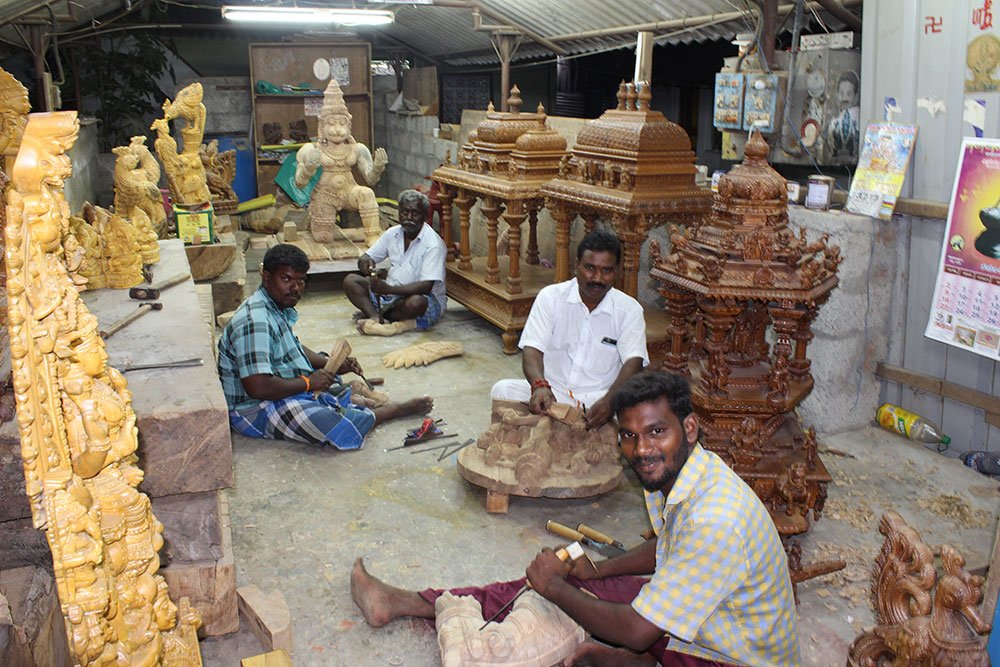
The primary objective of this unit is to advance the cut wooden items to National and International. The unit has a colossal assortment of wooden items, for example, Ganesha Wood sculptures, Krishna Wood sculptures, Saraswathi Wood sculptures, Shiva Wood sculptures, Buddha Wood Statues, Jesus Wood Statues, Wooden boards, Temple entryways, wooden chariots, and Pooja Maadam.
They use sorts of wood, mango, teak, coal black and pecan for wood cutting. The laborers are well gifted and experienced in wood making and make various sculptures.
An eight-feet Ganesha with complex carvings overshadows finely etched wooden figures that are dissipated over a work shed where craftsmans etch and slash. Gifted at cutting dolls out of a solitary square of wood, they endeavor to keep their appreciated tradition of wood cutting alive.
For over a century, these townspeople and their progenitors from Arumbavur and Thazhuthala, far off towns in Perambalur, have projected Gods and Goddesses in wood. The craft of wood cutting that has gone down through the ages as a family convention has become a Way of living for nearly one hundred fifty households inside the village.
“There are sufficient to hold the art alive.
At least one member in every own family has taken up wood carving.”
The idols and figures are essentially manufactured from 3 sorts of timber which include a unique type of timber referred to as Poovagai. “For three generations, They have used the Poovagai wood because the tree is believed to have unique houses. The leaves fold up at night time, giving the impact of a napping tree. The timber via smooth and pliable, is robust and weathers all conditions,”
The wood is carefully to be had in the area of Perambalur due to discount in inexperienced cowl due to expansion of highways, however can be observed in the Thanjavur-Kumbakonam belt.
The artisans use conventional gadgets like gouges for carving and consider there is no region for machines within the work.
“Earlier, one piece changed into accomplished by way of an unmarried artisan who knew the entire system. Today, we've at the least five artisans running on a single piece- from sizing the wooden, chiseling, carving the jewellery and sculpting the face, which calls for greater ability,”
Thirukkoilur Ulagalanda Perumal
It is situated on the Cuddalore – Chittoor trunk avenue and 37 kms from Villupuram. The presiding deities of the Vishnu Temple are Ulagalanda Perumal (Thiruvikrama Swamy) and Pushpavallithayar. Kabilar Kundru is likewise but some other picnic spot at Tirukoilur that is situated within the middle of the river Pennayar. Kabilar was a saint right here and his last resting location is maintained by way of the country Archaeological Department.
Thirunarungondai
It is 16 kms northwest of Ulundurpet and 21 kms east of Tirukoilur. Hillock at the village contains a Jaina cave and two temples committed to Parsvanatha and Chanraprabha. Cave served because the monastery of the clergymen of Virasangha within the eighth – ninth century A.D. Rich series of bronze photos discovered within the temple. Annual festival (Jan-Feb) celebrated on a grand scale and attended by Jains from all over Tamilnadu.
Melnariyappanur Church
A hundred 12 months vintage famous church is situated in Chennai – Selam toll road and 8 km from Chinna Salem. The church is built through the Kunchaan, a devotee of St. Anthoniyar. This church is located at Melnariyappanur is a village panchayat located close to Chinnasalem, in Kallakurichi Taluk of Villupuram District, Tamil Nadu. It is well-known for the shrine dedicated to the King of Miracles, Saint Antony of Padua. His feast is well known every year on June
Kalvarayan Hills
Kallakurichi is closer to Kalvarayan Hills. The proximity of clouds close to the peak of Vellimalai hilltop is a popular vacation spot for locals during the monsoon season. Vellimalai is a pristine unexplored location. There are so many villages in Kalvarayan hills’ hilltop and within the chilly of the climates in Eenadu.
It is one a part of the Eastern ghats, lies on the western side of the Kallakurichi Taluk. This region spread over a place of six hundred sq. Kms. Approximately with the peak ranging from 1000 toes to 3800 ft from the ocean level.
The History of Kalrayan hills with its Jagirdars run again to the time of Krishna Devaraya the Emperor of ‘VijayaNagar Kingdom’. The emperor Krishna Deverayar gave the rights to the tribes to enjoy this land however imposed many taxes on them.
About the hill tribes it's far stated that warriors belonging to ‘KARALAR’ network had come from Kanchipuram and settled in kalrayan hills. After every so often they over journey the tribal human beings referred to as ‘Vedar’ (hunter) and married their better halves. The groups of karalar and vedar who at present are known as ‘Malayali’ and that they call themselves as ‘Goundars’. Kalrayan hills possess innumerable tourism Potentialities like water falls, jungle streams, rivers and rivulets and adorable jungle walks.
The area is a veritable paradise for trekkers. It is likewise referred to as ‘Poor man’s hill station’ of Tamil Nadu. Every 12 months the District Administration is conducting the Summer Festival to create the notice of the various tribes.
Falls at Kalvarayan
Periyar Falls are placed in the Viluppuram district of the south Indian country of Tamil Nadu. They can be discovered at a distance of 15 kilometers from Kachirayapalayam. The perfect time to visit these falls is within the months of September to December, for the duration of the submitted monsoon season.
Periyar Falls are in near proximity with the Vellimalai village. The waft of water turns into much less throughout the summer months and the cascade is commonly flooded with the rains. The neighborhood humans enjoy bathing on the Periyar Falls, because it feels pretty safe. The foremost source of water to the cascade is the south east monsoon rainfall.
Their land called Punal forest changed into Patta land, Poramboke land and wooded area regions respectively. People of those areas paintings are difficult and are earned by cultivation. Although they get proper rains, they're unable to keep rainwater for irrigation purposes, as there is no absorption of rainwater in these hilly areas. Under those occasions the cultivation is hindered and is unlucky for them.
These hilly tribes lived until 1976 as slaves. Then the authorities had taken essential steps and slowly civilization was taking over the region. Till then it changed into under the control of the nearby rulers namely Jagirdars. Only in the course of 1976, the vicinity changed into taken over through the Government.
This became accomplished through the Maintenance of Internal Security Act (MISA) and Tamil Nadu Inam Estate Abolition and Ryotwari Act' below which the Jagirdars were deprived of strength and the Malayalis had been launched from the Bonded Labour system. Since then the Government and a few voluntary groups had been undertaking numerous developmental works in that area.
The tribal network of Kalvarayan Hills speaks a language in Tamil. They have been prepared into various exogamous corporations referred to as Vakuppar or Atappu or Kilai. Each Atappu consists of diverse smaller Patri-lineal exogamous agencies known as Vitu. Each Vitu includes several families. Normally monogamy is in exercise for a number of the Malayalis.
Agriculture is the principal profession in the Kalvarayan Hills. Millet types (ragi, varudu, samai, tinai, cholam, kambu) are being cultivated and in a few places paddy, pulses, chillies, purple gram, groundnut, tobacco, mustard, and types of beans also are grown as secondary cultivation. But it isn't on an everyday basis as 80% of the tribal network relies upon everyday salary labour in the place of agriculture. Within the identical hills they pass to different districts for their family profits.
The subsistence financial system also consists of fishing and low searching of rabbits, deer etc. Through this occupation they're not able to meet their every day bread as now not having normal profits. There are no healthcare & aid facilities for the entire tribal community in Kalvarayan Hills.
The Gomukhi dam, Megam Falls and Periyar falls at the foothills are the form of places that come up with the type of feeling you get while you splash bloodless, flower scented water to your face on a warm summer time’s day. Adventure Lovers and Trekkers will surely like Kalrayan Hill. These hills offer a temperate climate and a peaceful atmosphere. There is a beautiful botanical garden at the hills.
The tribal communities make for first rate observations. Large part of the hill variety remains unexplored and untouched except for some secluded tribal settlements. Kallakurichi is the nearest metropolis approximately fifty six KMs from Kalrayan Hills whilst Salem is about 70 KMs.
Koovagam Festival
Transgenders, popularly known as ‘aravanis’, are within the midst of celebrating the 18-day-lengthy Koovagam pageant, an annual occasion that draws their type from abroad, including Singapore and Malaysia, and from across the united states of america, consisting of Delhi, Maharashtra, Himachal Pradesh, Tamil Nadu and Karnataka.
Their focal point all through the fete is Koovagam temple, where the presiding deity is Aravan, to whom the ‘aravanis’ will get figuratively wedded on Tuesday night. During the Mahabharata struggle, Arjuna, a past grasp in archery, killed Aravan with the prowess of his bow and arrow. Therefore, it actually meant that the ones ‘aravanis’ wedded to Aravan were rendered widows in a single day.
Koovagam is a village in the Ulundurpet taluk in Kallakurichi district, Tamil Nadu. It is famous for its annual festival of transgender and transvestite individuals, which takes fifteen days inside the Tamil month of Chitrai (April/May).
The competition takes place in the Koothandavar Temple dedicated to Iruvan (Koothandavar). The participants marry the Lord Koothandavar, thus reenacting an ancient history of Lord Vishnu/Krishna who married him after taking the shape of a girl known as Mohini. The next day, they mourn the god Koothandavar's death through ritualistic dances and by breaking their bangles. An annual beauty pageant and numerous different competitions like making song contests are held.
Basic rights of transgender and transvestite people and fitness care are discussed in seminars too. People from distinct places attend this competition.
Location From Villupuram 25 km and from Ulundurpet 15 km.
Koovagam Koothandavar Festival – India’s Largest “Transgender Festival”.
The simplest pageant in Asia with all of the individuals as Transgenders takes vicinity in Tamil Nadu, the South Indian nation. Lasting for eighteen days at some stage in the Tamil months Panguni and Chithirai, that is between April – May, this specific Koothandavar festival is well known in a pomp way. Koovagam, the small village close to Vizhupuram within the South Indian kingdom of Tamil Nadu is the epicenter of this festival. The village is flooded with thousands of transgenders and general onlookers of the festival.
Transgenders, the 0.33 genders on this global, who've been quarantined via the society in maximum of the places due to the distinction of their body and behaviour. We have heard approximately these transgenders pushed out of their homes and earn their dwelling with the aid of doing numerous jobs. You would possibly have seen them at the same time as traveling in trains and for the duration of the nearby gala's. In maximum of the locations, in particular in North India, they are given the primary recognition in some of the fairs.
Senior members of such transgenders take care of the youngsters in their group and manual them to steer a respected dwelling. Unlike the earlier days, they have commenced to get employment even in the Government sectors and a number of them have emerged as writers and classical dancers diagnosed inside the global forums. Though they have numerous kinds of lifestyles, the centre factor bringing them all together is the Koothandavar festival celebrated every year.
The legend in the back of this competition is quite thrilling, referred from the Hindu mythological epic Mahabharata. Sacrificing a human is mandatory for winning within the Kurukshetra struggle, counseled through Krishna to the Pandavas. The 3 eligible men and women are Lord Krishna, Arjuna and his son Aravan as no person else volunteered. But except Aravan, the alternative are the fighters on the field, so Aravan volunteered himself, but expressed his wish that he wanted to experience the bliss of a wedding date before being crucified. As no girls came forward to marry him, who is going to die the day after today. So Lord Krishna himself took the shape of a girl named Mohini and married Aravan. As determined, Aravan changed into killed day after today and everybody knows the end result of the Kurukshetra conflict.
Besides the mythological details, within history also, we have come across such transgenders. One classical example is Malik Kafur who turned into the proper hand for the second maximum effective king of Khilji Kingdom, Allaudin Khalji. Joined as a soldier, with his colossal strength and bravery, he raised to take care of the complete military and improved the territories of Allaudin Khalji, especially in South India, defeating the Pandya Kingdom. He became this type of courageous fighter, notwithstanding his bodily deformity. He can’t be disregarded even as talking about the records of Mughal invasions in India and I could even say, the victories received by means of Malik Kafur, laid a sturdy foundation for the Mughal Empire to final for many centuries in South India.
The mythical incident is quoted because the base for the yearly competition is celebrated in Koovagam. There is a specific temple for Aravan named as Koothandavar, remembered for his sacrifice throughout the struggle. The transgenders from all components of the united states of america or even from the other South Asian nations arrive at Koovagam to participate in this competition. There are thrilling events ordinary throughout the duration to entertain the participants and the onlookers as nicely. Beauty contests, dance performances and different varieties of cultural activities are performed by the transgenders on all the days, where we should surely appreciate their calibre to take the existence in the maximum beautiful way.
The remaining but in the future is very auspicious all through this Koothandavar pageant. On this day, all of the transgenders dress up themselves as brides getting ready for his or her marriage. The priests tie them the mangal sutra on behalf of Aravan. It is thought that they all are representing Lord Vishnu inside the form of the fabulous Mohini, marrying Aravan on that day. Celebrations and glad entertainments are triumphant anywhere on the wedding day. Cultural programmes are performed and the human beings from Koovagam and different nearby villages and cities gather to witness the marriage of Aravan with the heaps of Mohinis.
The next morning is the Chariot procession which starts off with the idol of Aravan and it goes across the villages. This day is also very full-size that every one the Aravanis, who've married the Aravan the previous day, are putting off their mangal sutra, wearing a white saree, throwing their bangles and that they take the widowhood, symbolising the sacrifice of Aravan. You can see big cries everywhere mourning the demise of Aravan and his sacrifice. With those two days’ events the festival involves an cease.
There are special buses plying to Koovagam in the course of the festival and essential facilities are made by means of the Government and the neighborhood authorities. It is simply a completely unique enjoyment touring Koovagam during this festival, where the participants of the deprived community are the epicenters who revel in the handiest chance of getting married in their life.
Come and witness the Koothandavar festival, specific to Asia, unique to mankind, specific to the Transgender network.
To know more, please click the below link...
https://renghaholidays.com/