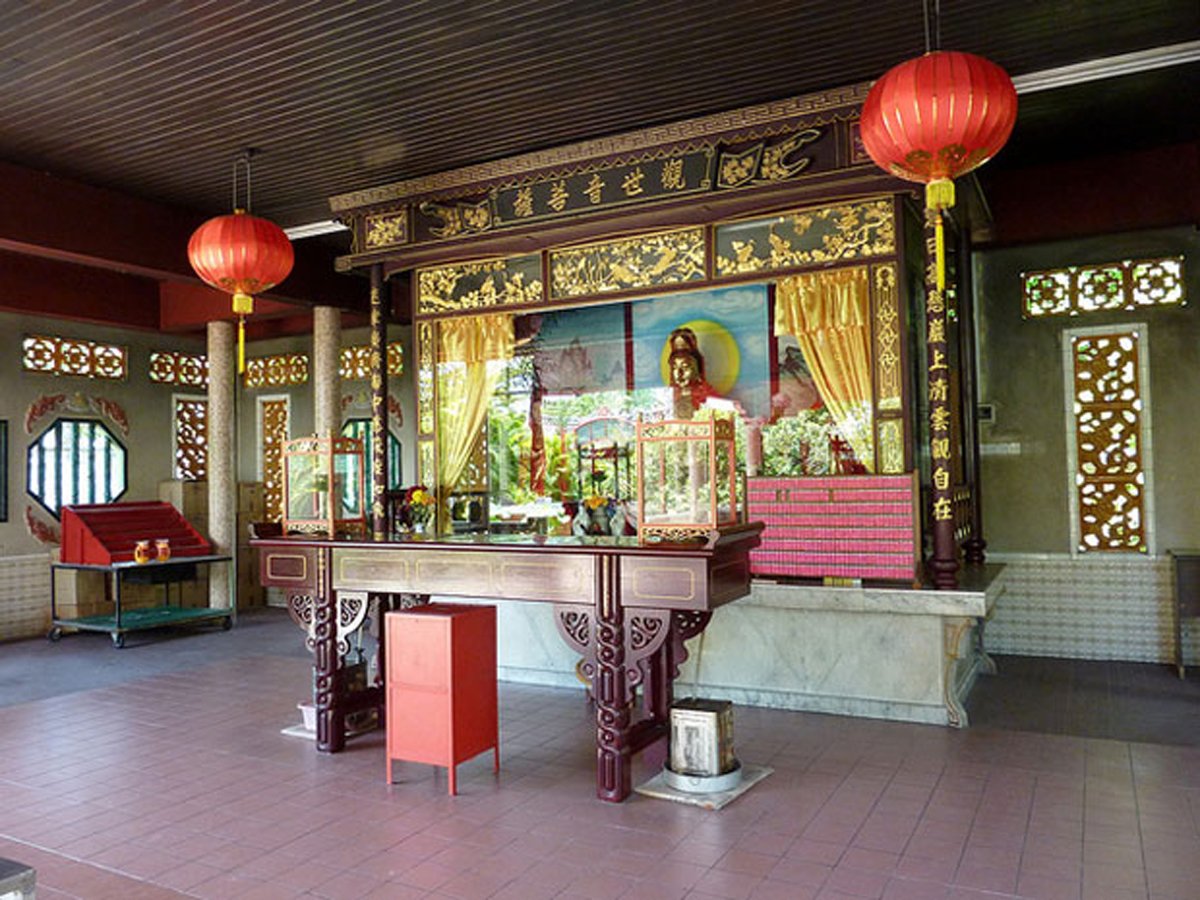
In 1850, a monk arrived from China bearing a statue of Chor Soo Kong. The monk built a temple dedicated to Chor Soo Kong in a clearing through the Sungai Keluang river in Bayan Lepas, Penang.
After the completion of the temple, snakes from the encompassing jungle began taking safe haven in the temple which quickly came to be known as "The Snake Temple".
The Snake Temple is a Chinese temple situated in Bayan Lepas, Southwest Penang Island District, Penang, Malaysia. It became constructed within 1805 for Chor Soo Kong , a Buddhist monk.
Devotees from as a long way away as Singapore, Taiwan and China come to want in the temple at the monk's birthday.The temple moreover featured all through the 8th leg of The Amazing Race 16 and emerge as a place in Tan Twan Eng's novel "The Gift of Rain"
History
The temple became built within the 1805 to honour Chor Soo Kong (additionally known as Qingshui), a Buddhist monk who lived at a few degree inside the Song dynasty (960–1279) for his severa right deeds in particular in recovery the unwell and giving secure haven to snakes. When the temple shape is completed inside the 1800s, snakes coming from the species of Wagler's pit viper reportedly regarded with the aid of themselves.
Features
The temple is filled with the smoke of burning incense and an expansion of pit vipers. The vipers are believed to be rendered innocent by using the sacred smoke, however as a protection precaution, the snakes had been de-venomed however still have their fangs intact. Other species of snake moreover to be had in the temple.
Visitors are warned towards choosing up the reptiles and setting them on their bodies to take images. Aside from the snakes, brick wells called the "Dragon Eye Wells/Dragon Pure Water Wells" are positioned within the temple together with big brass bells. In 2005, a snake breeding center changed into a setup within the temple.
The temple may additionally moreover as quickly as were surrounded by jungle however today it sits alongside a hectic toll road in an industrial property more than one kilometres from Penang's Bayan Lepas airport.
All these improvement approaches means that snakes in this region are few and some distance apart. It is whispered that the ones that are living within the temple in recent times are lower back to the temple's snake farm cages at night time time and brought out all over again every morning.
When you visited the temple there had been probably a dozen or so snakes, stated to be Wagler's Pit Vipers or Temple Pit Vipers, coiled round what seems like bamboo hats standing in front of the altar and in a facet room. There become some other snake draped on top of a vintage image frame just toes above human beings' heads, many of whom were unaware of its presence.
This may be all level-controlled for the travelers but these are real snakes, they'll be venomous and there is no glass or cages to restrain them.
Some say that the incense smoke makes the snakes drowsy and docile. Others say that the snakes are de-venomed and besides, no one has ever been bitten by one. Well, there's constantly a primary time so I became cautious to appearance wherein I became stepping and setting my arms.
Apart from the pit vipers, there were more than one massive pythons beneath the supervision in their handler who might assist you to wrap one your neck for an image possibility for a charge.
Every one year, hundreds of devotees make a ride to the temple for the duration of the birthday celebrations of Chor Soo Kong which, oddly, takes place three times every year, on the 6th days of the primary, sixth and 11th months of the Chinese lunar calendar. The rest of the year it is the tourists who make up the majority of the website visitors.
Besides the precept snake temple, there may be a further hall at the rear committed to Kuan Yin, the Goddess of Mercy. Other factors of hobby include a large bell, a couple of wells, and a small snake farm stated to comprise 50 species of snakes.
High at the listing of Penang's lengthy-promoted visitor points of interest is the Snake Temple. That call on my own evokes distinct mental photographs of a temple slithering with deadly vipers, cobras, and pythons, where you want to be careful in that you tread lest one sneak up on you from some nook or cranny. Think Snakes on a Plane, however in a temple.
Unfortunately, the call of the location is a hard and fast-up for sadness in case you move there with high expectations. It's best really worth going as a hobby, and simplest as a quick prevent-over on the manner to or from the airport, in which it is close to. Don't make a unique experience out here until you have been given simply nothing higher to do. It's loose, no longer less than. The fact is that it is little more than a run-of-the-mill Chinese temple.
The Penang Snake Temple is about three km from the airport in Sungai Kluang, Bayan Lepas. Built in honour of Chor Soo Kong, a Buddhist priest and healer, legend has it that the monk gave shelter to the snakes and whilst the temple modified into finished after his lack of lifestyles, they moved in on their personal.
WORSHIPPERS REGULARLY VISIT THIS BEAUTIFUL
Temple, located just beneath miles away from Penang Island’s airport. However, the fantastic location of worship has a unique entice: It’s filled with live pit vipers.
The Snake Temple (officially called Hock Hin Keong or Cheng Hoon Giam) changed into built inside the mid-19th century to honor Chor Soo Kong, additionally called Qingshui, a Buddhist monk and healer born in China at some point of the Song Dynasty (960–1279).
The legend holds that in his lifetime, Chor Soo Kong occasionally furnished refuge to close by jungle snakes. After the temple became erected in his honor, it’s stated snakes started showing up there of their very own accord.
Snakes apart, the temple is a lovely piece of architecture. In its earliest years it became a clean attap form, a conventional housing style found in the rural villages of Brunei, Indonesia, Malaysia, and Singapore. But after many years of enhancements and several fundamental renovations, it has blossomed right into a fantastic structure, presenting complicated detailing at the doors and rafter beams.
The number one temple opens right into a courtyard, wherein the Shrine Hall of Kuan Yin is located, allowing visitors to wonder at the cute plants that populate the garden.
Follow the pathway and you could arrive on the “snake pool,” in which snakes recline on trees among leafy green branches, both basking within the solar or taking safe haven inside the shade. The snakes are a concept to be kept docile way to incense being constantly burned.
Locals may even inform you that some of the snakes in question, which are Wagler’s pit vipers and inexperienced tree snakes, were de-venomed. Still, you’ll want to keep your arms and toes to yourself usually and look around earlier than you are taking a seat. It’s now not endorsed to carry small children, however, the temple is a tranquil spot and they claim that no person has ever been bitten.
Know Before You Go
The temple is located approximately a 25-minute pressure from downtown Penang, so each get a taxi, or capture the unfastened travel bus.
There is not a lot else around the temple, so don't forget to look to inform this in earlier than or after the airport. On your way to the courtyard, you can moreover visit the exhibition next to the temple, which incorporates pythons and cobras.
While entry to the temple is unfastened, you do have to pay for a photograph opportunity with those snakes. This is completely optionally available.
The architecture of Penang Snake Temple
The unique temple in its earliest years became just an easy tap shape decorated with purple and yellow patterned which was a famous traditional housing fashion in Indonesia, Malaysia and Singapore. However, after years and years of renovations and upgrades, the Snake Temple in Penang has now evolved into an outstanding structure with complex carvings and tapestries.
Not a ways away from the shrine is the ‘snake farm’ which is designed in this type of way that warmness doesn’t input the glass barriers within which baby snakes are allowed to develop and the wounded ones are allowed to heal.
The most important temple leads us to the courtyard in which the Shrine Hallo Kuan Yin is placed. There are slender pebbled pathways across the shrine which lead to a lovely pond vicinity with green, leafy bushes all around it on whose branches several snakes are living.
Legend of Snake Temple Penang
Constructed in 1805, the Snake Temple was created to pay homage to the Buddhist monk and healer- Chor Soo Kong, who became an outstanding parent inside the Song Dynasty technology. He changed into states to have won supernatural powers through his abilities in dharma and meditation and his uncanny ability to heal the wounded and the ill.
Chor turned very keen on snakes and his own house was often a refuge for an expansion of snakes and reptiles. Strangely, the identical cycle of activities came about in this temple wherein the Wrangler’s pit viper snakes are said to have appeared mysteriously as soon as the area became consecrated. Thus this temple, which turned into initially referred to as Temple of Azure Cloud, quickly followed the new call - Snake Temple.
Snake Temple (Hock Hing Keong)
Snake Temple (Hock Hing Keong) might not be the biggest Buddhist temple in Malaysia, however, it’s clearly one of the strangest. True to its call, this small Chinese temple in Penang is filled with Wagler's pit vipers and tree snakes perched on bushes and wood frames all through.
The smoke of the continually-burning incense, combined with noon warmness, renders the snakes in large part motionless, but traffic is nonetheless counseled to avoid dealing with the reptiles.
According to local legend, snakes started entering the temple on their own shortly after it became constructed inside the mid-nineteenth century, and the priests at the time allowed them to stay. The priests will inform you that the snakes are “blessed,” and that’s why they’ve by no means bitten all people.
The temple itself is free to enter, but for a small fee, you can additionally tour the onsite snake farm where it’s viable to see numerous species of snakes and take care of a few of them below professional supervision.
Snake Temple is a completely unique Chinese temple in Penang because of its exclusive records and features.
The temple is constructed to honor Chor Soo Kong, a Chinese Buddhist monk. Legend has it he's famous for recuperation and giving shelter to snakes. After finishing the temple's construction, snakes have seemed and lived inside the temple with no human touch. Snake Temple is complete with the smoke of burning incense and a selection of snakes this is visible everywhere right here.
Visitors are warned not to touch any reptiles unless being helped by way of the locals inside the temple. This tourist website is really worth even as a brief go to for everybody curious about the snakes in addition to the temple's records.
This festival is held in conjunction of the year of the snake in step with the Chinese Lunar Calendar and also the birthday of the “Cheng Chooi Chor Soo'' of Snake Temple.
The competition pursuits to sell cultural tourism in Penang and additionally to educate the younger era to comprehend and apprehend Malaysian culture and records.
Legend claims that snakes came to the temple of their very own accord within the mid-1800s after construction turned finished. Rather than dispose of the snakes, the monks gave them shelter. In gratitude, the snakes have never bitten all and sundry; humans and untamed poisonous vipers coexist in harmony.
The Snake Temple in Penang became built in 1850 to honor Chor Soo Kong - a monk deified for his severe right deeds, together with the recuperation of the ill and giving snakes from the close by jungle refuge.
Chor Soo Kong, born sometime between 960 and 1279, continues to be fantastically respected; pilgrims journey from throughout Southeast Asia to honor him on his birthday all through the first lunar month of each year.
The real name of the Penang Snake Temple is "Temple of the Azure Clouds" or "Ban Kah Lan" in Hokkien.
The maximum common snakes determined across the Penang Snake Temple are called Wagler's pit vipers. Native to Southeast Asia, Wagler's pit vipers are now usually known as "temple vipers'' due to the affiliation with Penang's Snake Temple.
Keen to sit motionless on bushes, the pit vipers are small, colorful, and come geared up with an effective hemotoxic venom. While destructively painful, the venom is not usually fatal to people.
During afternoon heat, the snakes are so still and motionless that they seem fake. The shiny, colorful markings almost provide the appearance of plastic; even the eyes stay transfixed. First-time traffic often mistook the snakes as fakes, discounting the temple as a bad visitor enchantment.
To make subjects worse, tacky symptoms positioned across the temple warn traffic of the hazard of the snake's gift. Make no mistake, the snakes are certainly actual.
Many sources say the snakes have had venom eliminated, however, the temple workforce declares that the snakes are poisonous, however "blessed" and have never bitten anyone. Either way, the snakes' fangs are nevertheless intact and able to give a totally painful bite. Obey the symptoms, do not cope with or contact the snakes!
To know more, please click the below link...
https://renghaholidays.com/